Second Most Powerful Man in the World : The Life of Admiral William D. Leahy, Roosevelt's Chief of Staff (9780399584817) by O'Brien Phillips Payson
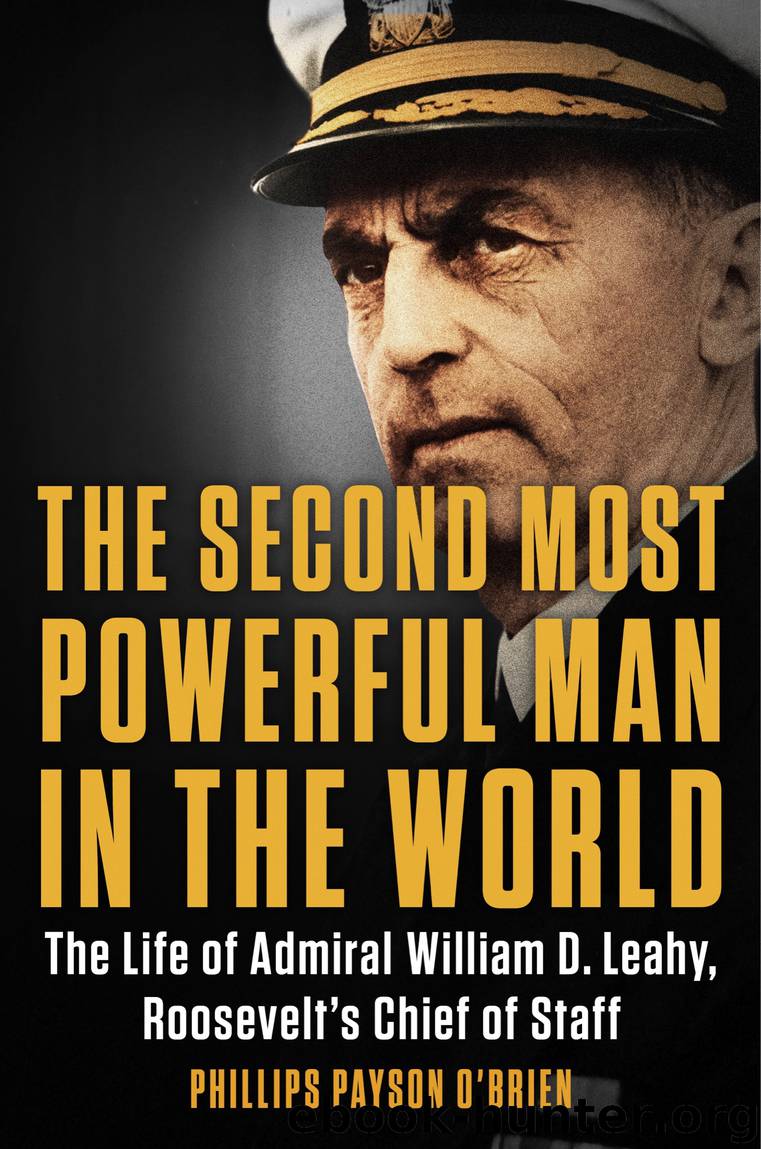
Author:O'Brien, Phillips Payson
Language: eng
Format: epub
Publisher: Penguin USA
Published: 2019-05-07T04:00:00+00:00
CHAPTER 22
Atomic Bombs and Elections
When the presidential train finally pulled into the siding by the Bureau of Engraving and Printing on August 17, Washington, DC, was bathed in the sedating light of victory. Nazi Germany seemed on the verge of a final collapse. When German defenses around Normandy had crumbled in late July, the Wehrmacht had been sent into a headlong retreat. Paris was on the verge of liberation, and soon the German Army would be back to almost the 1939 border of the Reich. On the eastern front, conditions seemed even worse for the Germans. The Red Army had launched a massive offensive, code-named Operation Bagration, which overwhelmed German troops. The Soviets surrounded and captured masses of German soldiers, more than had surrendered during any previous battle of the war. When the dust settled, approximately 400,000 Germans had been made prisoners and the Red Army had reached the outskirts of Warsaw. Many in Germany understood that Hitler had brought the country to an irretrievable disaster, and in late July a coup had been launched against the regime, including Claus von Stauffenberg’s assassination attempt on the German dictator. Though Hitler escaped with minor injuries, it seemed that the Nazi state might not survive to Christmas.
Washington, for the first time since Pearl Harbor, seemed a city at peace. While Congress was still formally in session (it would remain so for almost the entire war), with the 1944 elections looming, many politicians had left town to visit their home states. Others were away escaping the heat and humidity of the capital in August. The quiescent mood suited the president, who spent much of his time having long lunches under the magnolia tree in the White House garden or dozing through tea breaks on the sun porch. Leahy, however, was not allowed a break. He had to both prepare for an upcoming conference with the British in Quebec, Octagon, and catch up with what had been going on in the world while he and the president had been coasting slowly across the country.
Roosevelt continued handing Leahy control over the most delicate issues. In August 1944, one of the more tragic events of a very tragic war commenced when the Polish population of Warsaw began an uprising against their German occupiers. The Red Army, which was only miles away, refused to help, happy to let the Poles and Germans kill each other so that they could sweep up the mess afterward.
When Roosevelt returned to Washington, he was besieged by the Polish ambassador and foreign secretary, who were frantic to get aid to their fellow citizens. With the election approaching, it was both a strategic and political question for Roosevelt, who was worried about the state of Polish-American opinion. Knowing he could trust the admiral, he told the Polish diplomats that they were to use Leahy as the best conduit to himself.1 It was a bittersweet obligation for the admiral. He wanted to get aid to the Poles, but he had already accepted that the
Download
This site does not store any files on its server. We only index and link to content provided by other sites. Please contact the content providers to delete copyright contents if any and email us, we'll remove relevant links or contents immediately.
| U.K. Prime Ministers | U.S. Presidents |
Waking Up in Heaven: A True Story of Brokenness, Heaven, and Life Again by McVea Crystal & Tresniowski Alex(37815)
Empire of the Sikhs by Patwant Singh(23090)
We're Going to Need More Wine by Gabrielle Union(19054)
Hans Sturm: A Soldier's Odyssey on the Eastern Front by Gordon Williamson(18596)
Leonardo da Vinci by Walter Isaacson(13341)
The Radium Girls by Kate Moore(12036)
Tools of Titans by Timothy Ferriss(8403)
Educated by Tara Westover(8061)
How to Be a Bawse: A Guide to Conquering Life by Lilly Singh(7494)
Permanent Record by Edward Snowden(5852)
The Last Black Unicorn by Tiffany Haddish(5643)
The Rise and Fall of Senator Joe McCarthy by James Cross Giblin(5284)
Promise Me, Dad by Joe Biden(5157)
The Wind in My Hair by Masih Alinejad(5103)
A Higher Loyalty: Truth, Lies, and Leadership by James Comey(4967)
The Crown by Robert Lacey(4821)
The Iron Duke by The Iron Duke(4367)
Joan of Arc by Mary Gordon(4117)
Stalin by Stephen Kotkin(3973)
